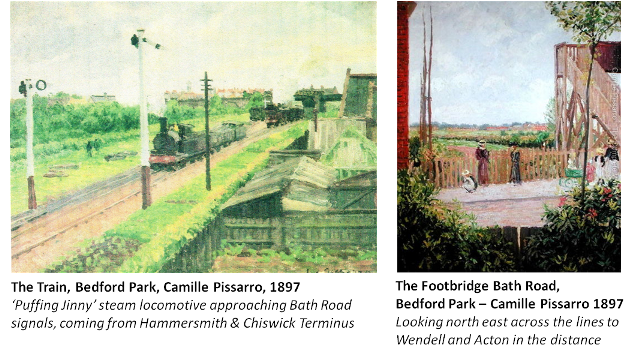
The great French Impressionist painter, Camille Pissarro (1830-1903), spent his final visit to England at 62 Bath Road, Bedford Park - the last house in Bath Road before the railway crossing and Stamford Brook. His son, Lucien (later to move to the Brook Cottage), had just moved there from Essex, having suffered a severe stroke.
The timing was 7 May to 19 July 1897 when the Diamond Jubilee of Queen Victoria was celebrated. There were cricket matches on the cricket field, ‘Puffing Jinny’ was steaming back and forth on the North & Southwestern Junction line (see 'The Train Comes & Goes''The Train Comes & Goes') and the brick field had been cleared for house building. During these two months, Pissarro painted seven views, all from the front and back of the house, where he set up his easel on the flat roof (which can still be seen from Welstead Way). They were all entitled ‘Bedford Park’ but six of the paintings are of Stamford Brook. Pissarro was unaware that although he was in Bedford Park, he was looking towards Stamford Brook.
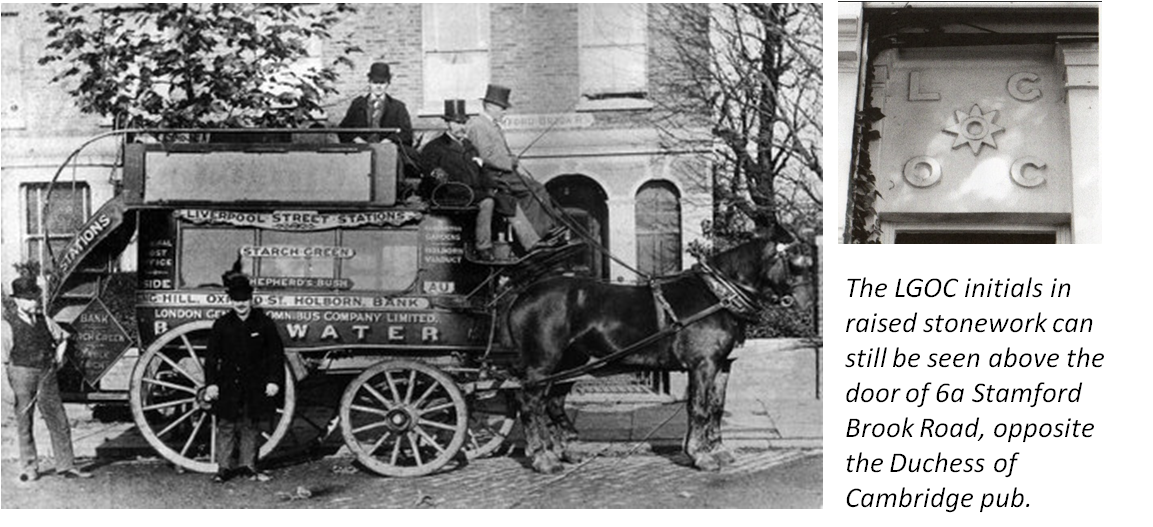
Who would guess that the 94 bus route could have so much history behind it? It turns out that there has been an 'omnibus' stop outside the Duchess of Cambridge Pub since the late nineteenth century. In those days, the omnibuses were horse-drawn and Stamford Brook was the terminus. For those of you who think the international flavour of the area is recent, the story of the London General Omnibus Company (LGOC) is illustrative. It was formed on 1 January 1859 and replaced the original joint Anglo-French company called the Compagnie Générale des Omnibus de Londres, founded in 1855! The new company began operating horse bus services in London in 1856.
The LGOC stabled horses for the buses that served Bedford Park in Stamford Brook Road, opposite the Duchess (then called the 'Queen of England'). The stables were there until 1909 when the horses began to be replaced by the petrol engine but the evidence is still there. The LGOC initials in raised stonework can still be seen above the door of 6a Stamford Brook Road, opposite the Duchess of Cambridge pub.
Sybil Pearce, a Bedford Park resident born in 1900, wrote fondly of the horse drawn buses in her wonderful memoirs:
‘Some of my favourite days were those on which my Mother decided to go ’up to town’ shopping. We would catch a two-horse omnibus in the Bath Road outside the Tabard Inn and my great joy was to seat myself just behind the driver on the top of the ‘bus in the front seat. I remember one driver in particular – a fat, red haired man wearing green woollen mittens. I loved the way he brandished his whip and clucked his teeth at the horses.'
From 'Sybil Pearce - An Edwardian Childhood in Bedford Park’
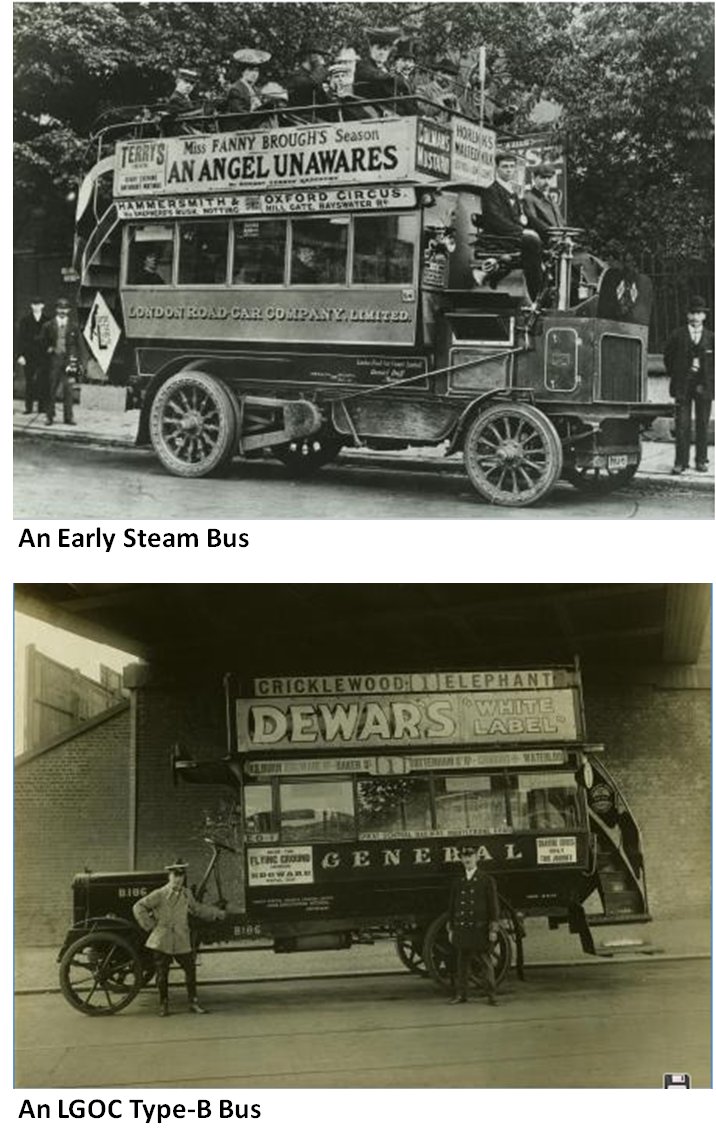
The opening of the Central London Railway (Central Line) in 1900 gave the LGOC stiff competition for the first time, and it started to experiment with a new technology: motorbuses. First, steam buses, then combustion engines, of which the most famous was the B-Type. They quickly proved themselves as safe and reliable, and so the last horse bus ran on 25 October 1911.
This is when the London bus system we know started to be formed. Horse buses had been painted a variety of colours for different routes. But from 1907 all LGOC motorbuses were painted red with numbers differentiating routes. The Metropolitan Police also insisted that every bus clearly displayed route and destination boards front and back.
In 1921 the LGOC, later called London Regional Transport, moved its vehicle storage and maintenance to a large site opposite Gunnersbury Station. The link with Bedford Park was broken. For many years, this was a major London bus garage, before being redeveloped as the Chiswick Park business park development, leaving just the Acton depot behind it.
Stamford Brook today is dominated by a single District Line viaduct that cuts across the area from East to West. This was originally built by the 'London and South Western Railway' (L&SWR) and by the 1850s, it had already connected Ealing and Richmond to the City with lines that crossed Acton Green. From the 1850s to the First World War, Stamford Brook was the centre of a railway boom with various companies competing to offer the quickest route into the City to local residents. The L&SWR had initially been built without a stop at Stamford Brook and for a while three different railway companies shared the lines to Richmond in addition to the L&SWR (see Wikipedia for details). By the time Stamford Brook station was opened in 1912 only the L&SWR and the District Railway were still using it. Eventually the L&SWR ceased operations leaving it to the District Railway (which later became the District Line of the London Underground).
One of the One of the eventual losers in this battle was our own ‘lost’ railway through Stamford Brook - the Hammersmith branch of a railway called the North and Southwestern Junction Railway (NSWJR) which ran from Kew, via South Acton to the City. This branch line existed until the 1960s and ran behind the gardens of the houses on the west side of Emlyn Road, on the land now converted to allotments and the Emlyn Gardens estate. See the wonderful video from 'The Londonist' below:
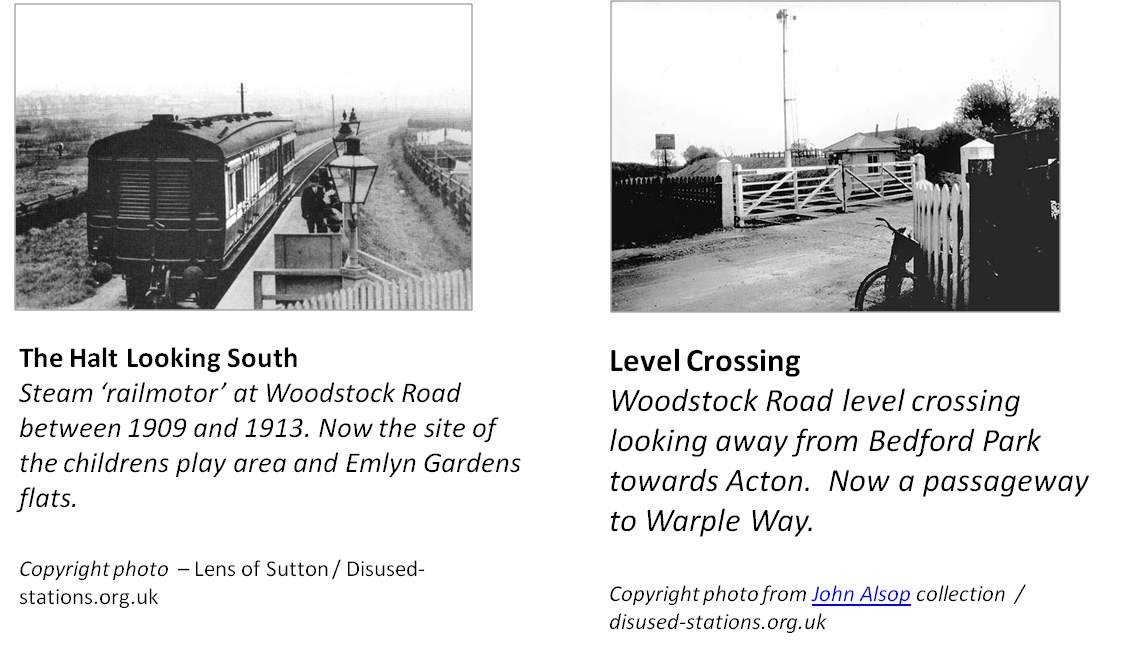
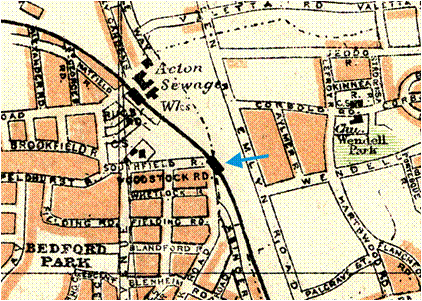
Started in 1857, the line was designed to pick up passengers at a now dissappeared 'Hammersmith & Chiswick Station' at the Stamford Brook end of Chiswick High Road (where the modern flats now stand next to Chiswick Auctions). The line then curved left behind what are now Hatfield and Greenend Roads. The original line of the railway marked on the line on which these houses were later built. The pumping station at Warple Way now sits on the railway site. It curved further round to link up to the main part of the line, the NSWJ’s Kew to Fenchurch Street line (now the London Overground line to Richmond) at the Acton Gatehouse Junction. This rather awkwardly left the carriages facing the wrong way for journeys onto the City and the passengers had to change.The line ran north from there and crossed Bath Road where there was a level crossing with a footbridge (next to where the Seventh Day Adventist Church now stands). This footbridge was painted by Camille Pissarro during his stay in the area and was there until about 1930. The level crossing gates were in use, stopping traffic in the Bath Road, until 1965. The line continued north on the land now covered by allotments behind Abinger Road and Emlyn Road.
After Stamford Brook Station was opened in 1912 on what became the District Line, passengers drifted away from the Acton to Hammersmigh branch line, as the District offered a simpler journey into the City. In response, the NSWJ opened three extra 'halts' to try and pick up more passengers on the line. These were at Bath Road, Woodstock Road and Rugby Road.
However the branch line was never able to compete against the quicker and more convenient route into London, which brought a drop in passengers to a line that was already running at a loss. The passenger service was withdrawn in 1917. During World War II, the line carried a mobile anti-aircraft gun, up and down behind the houses on Abinger, and the daily freight train continued to operate into the 1960s. All services were withdrawn on 3 May 1965 and the track was lifted shortly afterwards. The only memory of it is in Camille Pissaro's paintings and some rare photos shown here.
In the 1860s, numerous new schemes were promoted for railways to reach Richmond. The London & South West Railway (LSWR) obtained an Act on 14 July 1864 for a line from the north end of Kensington through Hammersmith to Richmond.
The LSWR's new route opened on 1 January 1869; it was from north Kensington, turning south through its own 'Shepherds Bush' and 'Hammersmith' (Grove Road) stations - neither this line or the two station still exist. After Hammersmith it then turned west along the alignment that is now the District line on the brick viaduct that cuts across Stamford Brook, then turning south-west through Brentford Road station (now called Gunnersbury), crossing the Thames to Richmond.
This new line crossed over the existing LNWR lines at Stamford Brook on its way to Turnham Green. At this point, there was no station at Stamford Brook (see note on station below).
Some websites for further reading on the London & Southwest Railway:
Warning: "continue" targeting switch is equivalent to "break". Did you mean to use "continue 2"? in /home/a00000y8/public_html/modules/mod_jf_mobilemenu/helper.php on line 83


 The opening of the Central London Railway (Central Line) in 1900 gave the LGOC stiff competition for the first time, and it started to experiment with a new technology: motorbuses. First, steam buses, then combustion engines, of which the most famous was the B-Type. They quickly proved themselves as safe and reliable, and so the last horse bus ran on 25 October 1911.